
Namaste, and welcome. If you’re about to land in Germany and the thought of getting from the airport to your hotel with your parents, your kids, and six suitcases is already giving you tension, take a breath. This guide fixes exactly that.
An Indian taxi service in Germany is a private, fixed-price cab with a driver who speaks Hindi, Punjabi, Urdu, or English and understands how Indian families actually travel. From a Frankfurt base, one WhatsApp message covers your airport pickup and any long-distance ride across the country, from Stuttgart to Cologne to Nuremberg. You agree the full price before the wheels move, so there’s no meter climbing while you sit in traffic and no surprise at the end.
I’ve written this the way I’d explain it to my own cousin landing here for the first time. Plain talk, real distances, honest answers, and no salesy nonsense. Read the parts that matter to you and skip the rest.
The first fifteen minutes in Germany decide your whole trip
Here’s something nobody warns you about. The stress of a Germany trip almost never happens at the Eiffel Tower or the castle. It happens in the first fifteen minutes after you walk out of arrivals, jet-lagged, with everyone looking at you to know what to do next.
You’ve been flying for nine hours. The kids are cranky. Your mother’s knees hurt. And now you’re standing in front of a wall of signs in German, trying to work out which train goes where, while strangers rush past you.
That single moment is where a good driver earns every euro.
The airport moment, handled
When your ride is pre-booked, none of that panic starts. Your driver is already standing at arrivals with your name on a board. He knows your flight number. He watched it land. Your bags go straight into the boot, your family gets into a clean car, and you leave. No queue. No haggling. No guessing.
Key takeaway: a pre-booked cab turns the scariest part of the trip into the easiest.
The language relief
For a lot of Indian families, the real fear isn’t the road. It’s the language. What if the driver doesn’t understand you? What if you can’t explain where you need to go?
With a Hindi-speaking driver, that fear disappears in the first sentence. You explain your hotel in your own words. You ask to stop for food. You tell him your father needs a slower pace. He gets it, because he’s Indian too and he’s done this hundreds of times.
The luggage reality
Indian families do not travel light, and there’s no shame in that. Gifts for relatives. Pressure cookers. A month of clothes. Snacks from home because who trusts foreign food on day one.
A private cab plans for that. You say how many bags, the right size vehicle comes. Anywhere from one to ten pieces of luggage is normal here, plus a stroller or a wheelchair if you need it. Compare that to dragging it all up and down train station stairs, and the choice makes itself.
How the fixed-price booking actually works
The biggest worry Indian travelers carry is a simple one. Will I be cheated? You’ve heard the stories. The meter that runs too fast. The tourist price. The extra charge that appears out of nowhere at drop-off.
This is why the whole thing runs on fixed pricing. You get one number before the trip, and that number is what you pay. Full stop.
What to send when you book
Booking is a short WhatsApp chat, not a website with forms and passwords. Send these four things and you’re basically done:
- Pickup point (for arrivals, that’s Frankfurt Airport, Terminal 1 or Terminal 2)
- Destination (your hotel, home, or the next city)
- Date and time of your flight or trip
- Number of passengers and bags
Add anything extra, like a child seat or a stop on the way for food. You’ll get a fixed quote back. If it works for you, you confirm. That’s the entire process.
Why fixed price beats a meter
A meter punishes you for things you can’t control. Traffic jams. Roadworks. A wrong turn. With a fixed price, all of that is the driver’s problem, not yours. You already know the cost, so you can relax and actually look out of the window.
Key takeaway: fixed price means you plan your budget before you fly, not after you land.
How you pay
No prepayment stress. You’re not sending money to a stranger before you’ve even met them. You settle after the ride, the way it should be, with the exact number you were promised at booking.
Every major German city you can reach by cab from Frankfurt
Frankfurt sits close to the middle of Germany, which is exactly why it makes such a good base. Long-distance rides go in every direction, and the Autobahn network makes them faster than you’d expect.
Here are the popular routes with real road distances and honest drive times. I checked these against actual driving figures, not the straight-line numbers you sometimes see online, which run short and set the wrong expectation.
| Route from Frankfurt | Road distance | Typical drive time | Region |
|---|---|---|---|
| Mannheim | about 80 km | around 50 minutes | Rhein-Neckar, Baden-Württemberg |
| Heidelberg | about 90 km | around 1 hour | Rhein-Neckar, Baden-Württemberg |
| Karlsruhe | about 140 km | around 1.5 hours | Baden-Württemberg |
| Cologne (Köln) | about 190 km | around 2 hours | North Rhine-Westphalia |
| Stuttgart | about 210 km | around 2 hours | Baden-Württemberg |
| Nuremberg & Fürth | about 225 km | around 2.5 hours | Bavaria, Franconia |
| Düsseldorf | about 230 km | around 2.5 hours | North Rhine-Westphalia |
| Aachen | about 230 km | around 2.5 hours | North Rhine-Westphalia |
| Ruhr area (Essen, Dortmund, Duisburg) | about 250 km | around 2.75 hours | North Rhine-Westphalia |
| Hannover | about 355 km | around 3.5 hours | Lower Saxony |
| Bremen | about 440 km | around 4.5 hours | Northern Germany |
Because it’s your private car and not a bus on a schedule, you set the stops. A washroom break for grandma. A tea halt. A photo by the Rhine. Nobody is rushing you back onto a coach.
Now let me walk you through each region properly, because the drive is only half the story. Where you’re going and who lives there matters too.
Mannheim and Heidelberg: the short, high-value runs
Mannheim is barely 80 km from Frankfurt, under an hour. Heidelberg is about 90 km, roughly an hour. These are two of the most-booked routes, and it’s usually parents doing the booking.
Heidelberg has one of the oldest universities in Germany, so it’s full of Indian students. Half the trips here are mothers and fathers coming to see their child, check the apartment, meet the flatmates, and quietly leave behind some pickle and dry snacks. After the visit, the castle and the old bridge over the Neckar make a lovely afternoon.
Mannheim sits right next door in the Rhein-Neckar region, an industrial and business hub. If you’re combining a Heidelberg visit with a Mannheim meeting, one driver can hold the whole day together.
Karlsruhe: the university and tech city
Karlsruhe is about 140 km from Frankfurt, close to an hour and a half. It’s a research and technology city with a strong engineering reputation, which means a steady flow of Indian students and IT professionals.
The drive down the A5 is easy and mostly flat. For a new student arriving with two big suitcases and no idea where the campus is, a door-to-door drop is worth far more than the money saved on a train that leaves them stranded at the station.
Stuttgart: car country and family visits
Frankfurt to Stuttgart is about 210 km, roughly a two-hour drive on the A6. This is the heart of German car manufacturing, home to some of the biggest automotive names, so it draws a lot of mechanical and automotive engineers from India, especially from Maharashtra and Gujarat.
That means a big share of these trips are family visits. Parents coming to see a son who moved for a job. A wife and kids flying in to join a husband who came ahead. Relatives arriving for a wedding or a new baby.
The route passes close to Heidelberg and Mannheim, so it’s easy to build a day that sees more than one place. A good driver knows where the clean rest stops are, which matters a lot when you’re traveling with elderly parents.
Key takeaway: for family visits with luggage and elderly passengers, the two-hour Stuttgart run in a private car beats a train change every time.
Cologne and Düsseldorf: the busy Rhine region
Cologne is about 190 km from Frankfurt, close to two hours along the A3, with Koblenz and Bonn on the way. Düsseldorf sits a little further at around 230 km. Both are in North Rhine-Westphalia, the most populous state in Germany, and both have large, well-settled Indian communities.
These routes stay busy year-round. Weddings, business travel, big family gatherings, and airport connections for people whose flights come through Frankfurt rather than the smaller local airports.
Cologne’s cathedral is worth seeing even if you’re only passing through. Ask the driver, and a short stop is easy to arrange since the ride is yours, not a shared shuttle.
Nuremberg and Fürth: the Franconia base
Frankfurt to Nuremberg is about 225 km, roughly two and a half hours on the A3. Fürth sits right beside it, so the two often get booked together.
Franconia, the northern part of Bavaria, is a strong tech and manufacturing region, which brings in a lot of Telugu, Kannada, and Tamil professionals working in engineering and software. English works comfortably for these trips, and the driver understands the rhythm of an Indian family regardless of home state.
Nuremberg’s old town is genuinely beautiful, and in winter its Christmas market is one of the most famous in the country.
The Ruhr area: Essen, Dortmund and Duisburg
The Ruhr core sits about 250 km from Frankfurt, close to three hours depending on which city you’re heading to and how NRW traffic is behaving that day. This is a dense, connected belt of former industrial cities that now hold some of the largest South Asian communities in Germany.
Pickups and drops here are frequent, and often it’s for extended families spread across several of these neighbouring cities. One private car can hop between Essen, Dortmund, and Duisburg in a way no single train ticket ever could.
Aachen: the border-city arrival
Aachen sits right on Germany’s western edge, near the Belgian and Dutch borders, about 230 km from Frankfurt. It’s a serious student and research city, so a good chunk of these trips are new arrivals starting their studies.
Landing in a new country and then trying to reach a border city by train, with all your worldly belongings, in a language you don’t speak, is a rough first day. A driver who takes you straight to your door removes the whole ordeal.
Region Hannover: the northern stretch
Frankfurt to Hannover is about 355 km, roughly three and a half hours. It’s a long one, but a comfortable private car makes it painless compared to a train journey that involves changes and heavy bags.
Hannover is a trade-fair city with a steady stream of business travelers, plus families visiting relatives settled in Lower Saxony. For a group of four or five with luggage, the door-to-door comfort easily justifies the ride.
Bremen: the far north
Bremen is the longest trip on this list, about 440 km and close to four and a half hours up in the north. Nobody pretends that’s a short hop.
It’s worth a cab mainly for families or groups who simply don’t want to spend the entire day on a multi-leg train relay with children and suitcases. When the alternative is exhausting, the private car is the merciful choice.
The language question, answered honestly
This is where a lot of services fudge the truth, so let me be straight with you.
The driver speaks Hindi, Punjabi, Urdu, and English, plus German and Italian. For most North Indian families, that removes the language worry completely from the very first sentence.
Now the honest part. We do not claim to speak Tamil, Telugu, Malayalam, Bengali, Marathi, Gujarati, or Kannada. If any service tells you it speaks all ten Indian languages, be a little careful, because that’s usually not true.
What families from those states get instead is clear, patient English and a driver who genuinely understands Indian travel. The food stops. The prayer breaks. The way we move as a family, with the elders first and nobody left behind. In practice, most South Indian professionals and students in Germany are perfectly comfortable in English, and these rides run smoothly every day on exactly that.
Here’s a quick sense of who travels these roads:
- Hindi and Urdu speakers from North and Central India, across Frankfurt, Berlin, and the university cities
- Punjabi families and business owners who want that apna driver feeling in Europe
- Tamil, Telugu, and Kannada tech workers and students, clustered around Munich, Stuttgart, and Berlin, served in English
- Malayalam-speaking healthcare and IT families, a community with deep and long roots in Germany
- Bengali academics and researchers, and Marathi and Gujarati engineers and entrepreneurs in the industrial south
Key takeaway: honesty about language is a feature, not a limit. You know exactly what you’re getting before you book.
Traveling with parents, kids, and elderly relatives
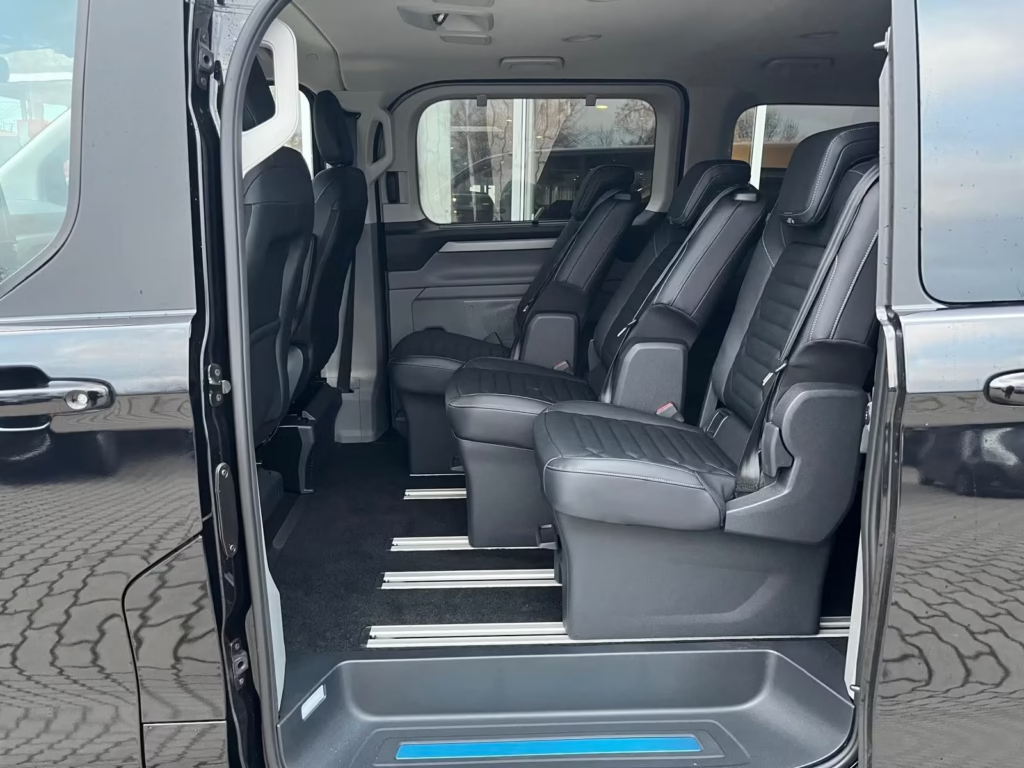
Safety here is practical, not a poster on the wall. When you’re carrying the two most precious groups, your children and your parents, the small details are what actually matter.
For young children
Child seats are available on request. Ask for one when you book so it’s fitted and ready before pickup, not something you’re scrambling to sort out at arrivals. The cars are non-smoking and clean, which every parent notices the moment they open the door.
For a long ride like Stuttgart or Cologne, tell the driver in advance so he can plan a break at a rest stop with proper facilities. A two-hour drive with a toddler is far easier when there’s a planned pause built in.
For elderly parents
Door-to-door is the whole point for older passengers. A few steps from the front door to the car, and a few steps from the car to the destination. No stairs. No long platform walks. No standing in a crowd with bags.
If a parent has mobility issues, mention it at booking. The right vehicle and a driver who takes his time make a genuine difference.
A quick real-world note
I’ve watched new arrivals visibly relax the second someone greets them by name at the exit. For an older traveler who’s nervous about a foreign country, that familiar face and a few words in Hindi do more than any brochure ever could.
For students landing in Germany for the first time
If you’re a student arriving alone, this section is for you. The first week in Germany is a blur, and the airport is the very first hurdle.
The arrival day
Your flight lands, often early morning after a long haul. You’re tired, you’ve got everything you own in two suitcases, and you need to reach an apartment or dorm you’ve never seen, possibly in another city.
A booked pickup means you don’t have to solve that puzzle while exhausted. You walk out, meet your driver, and go straight to your address.
The luggage math
Students carry a lot on that first flight because they’re moving, not visiting. Bedding, kitchen basics, a year of supplies. That’s genuinely hard to manage on a train with changes and stairs. A private car with proper boot space solves it in one trip.
University and city transfers
Common student routes from Frankfurt include Heidelberg, Karlsruhe, Aachen, and the Franconia cities around Nuremberg. Getting dropped right at the university gate or the student housing, instead of a distant station, saves you an anxious, bag-laden trek on day one.
Key takeaway: your first day sets the tone. Start it calm, not lost at a train station.
Taxi, train, or rental car: which one actually fits you
I’m not going to pretend the cab is always the answer. It isn’t. Let me give you the honest comparison so you can choose properly.
| Option | Best for | The weak spot |
|---|---|---|
| Private Indian cab | Families, heavy luggage, kids, elderly, no German | Costs more than a single train ticket |
| Train (regional or ICE) | Solo travelers, light bags, tight budget | Platform changes, stairs, carry your own bags |
| Rental car | Confident drivers who want full independence | Foreign signs, parking, deposits, navigation stress |
When the train wins
If you’re one person with a backpack and a bit of time, the train is cheap and efficient. Germany’s rail network is good. For a solo budget traveler, honestly, take it.
When the rental car wins
If you’re comfortable driving on the Autobahn, happy reading German road signs, and you want total freedom to roam, a rental works. Just budget for parking headaches and the mental load of driving in an unfamiliar country.
When the cab wins
Family of five with eight suitcases and two tired grandparents? The cab wins on sanity, not just comfort. The extra cost buys you a calm arrival, no lost family members, and no meltdown on a crowded platform.
Practical things first-time visitors should know
This is the stuff the taxi websites skip, and it’s the stuff that actually helps. Consider this your quick survival list.
- Get a local SIM or eSIM early so your family can share live locations and use maps. Sort it before you fly or right after you land.
- Carry a warm layer in your hand luggage. Germany is colder than most of India almost year-round, and grey, rainy days are common outside summer. Don’t bury the jacket in a checked bag you can’t reach.
- Keep some euros in cash. Cards work widely, but small shops and some services still prefer cash. Handy for tips too.
- Vegetarian and Jain food is available. Frankfurt and the bigger cities have plenty of Indian restaurants. If your family eats strictly vegetarian or Jain, say so while planning, and food stops can be chosen around it.
- Keep documents easy to reach. Passport, visa, and hotel booking will be needed in the first day, so don’t pack them deep.
None of this is scary once someone lays it out for you. That’s the whole reason traveling with people who understand where you’re coming from makes such a difference.
Common mistakes to avoid at Frankfurt airport
A few small errors trip up almost every first-timer. Dodge these and your arrival goes smoothly.
- Don’t grab a random taxi from the rank without knowing the fare. That’s exactly where meter surprises happen.
- Don’t assume the train is simple with a big family. It can mean stairs, changes, and self-carrying every bag.
- Don’t book a ride that can’t track your flight. If your plane is delayed and the driver doesn’t know, you either wait or pay for the gap.
- Don’t leave your pickup to chance. Arrange it before you fly, so the moment you land, someone is already waiting for you.
Key takeaway: the single best thing you can do is book your ride before you get on the plane.
Frequently asked questions
Is there really an Indian taxi service in Germany?
Yes. From a Frankfurt base you can book a private Indian cab with a Hindi, Punjabi, Urdu, or English speaking driver for airport pickups and long-distance rides across Germany. The price is fixed and agreed before the trip, so there are no meter surprises.
Can I get a cab from Frankfurt airport to another city?
Yes, that’s one of the most common bookings. Popular runs include Frankfurt to Heidelberg (about an hour), Stuttgart and Cologne (about two hours each), Nuremberg (about two and a half hours), and longer trips up to Hannover and Bremen. You arrange the whole ride in advance.
Do you have a Hindi-speaking driver?
Yes. The driver speaks Hindi, Punjabi, Urdu, and English, plus German and Italian. Families from South Indian states are served comfortably in English by a driver who understands Indian family travel.
Are child seats available?
Child seats are available on request. Ask for one when you send your booking so it’s fitted before pickup. The cars are clean and non-smoking, which parents always appreciate.
How much luggage can you take?
The service handles anywhere from one to ten pieces of luggage. Tell the driver the bag count when booking so the right size vehicle is sent for you.
What if my flight gets delayed?
Airport pickups include flight tracking. If your flight is late, the driver already knows and adjusts, and you won’t be charged for waiting time that wasn’t your fault.
Is a private cab worth it compared to the train?
For families, heavy luggage, small kids, or elderly parents, usually yes. The comfort and the calm arrival are worth the extra cost. For a solo traveler with light bags, the train is often the smarter, cheaper choice, and there’s no shame in taking it.
Your ride is ready when you are
A trip like this often takes months of saving and a lot of hope. Parents planned it. Kids counted down to it. The last thing anyone wants is for the memory to start with a fare argument or a family lost at a station with eight bags.
A reliable ride isn’t a luxury on a trip like that. It’s the thing that lets the holiday actually begin the moment you land.
So do the one thing that makes the biggest difference. Book your ride before you fly.
Chalo, tension chhodo. WhatsApp or call Sunny Singh at +49 1521 3625157 with your pickup, destination, date, and number of passengers, and you’ll get a fixed price straight back. Fixed price, full safety, and a familiar voice waiting for you in Germany. More details at namastetrip.de.