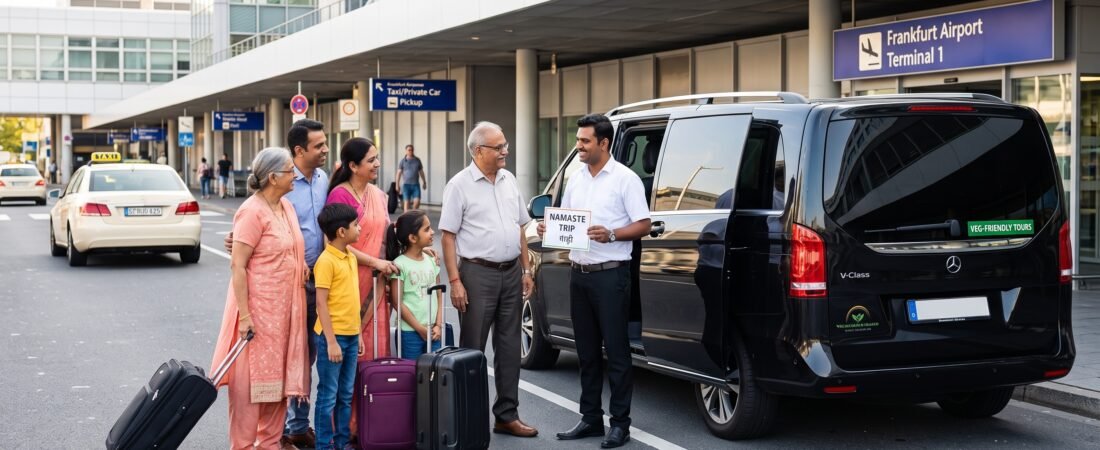
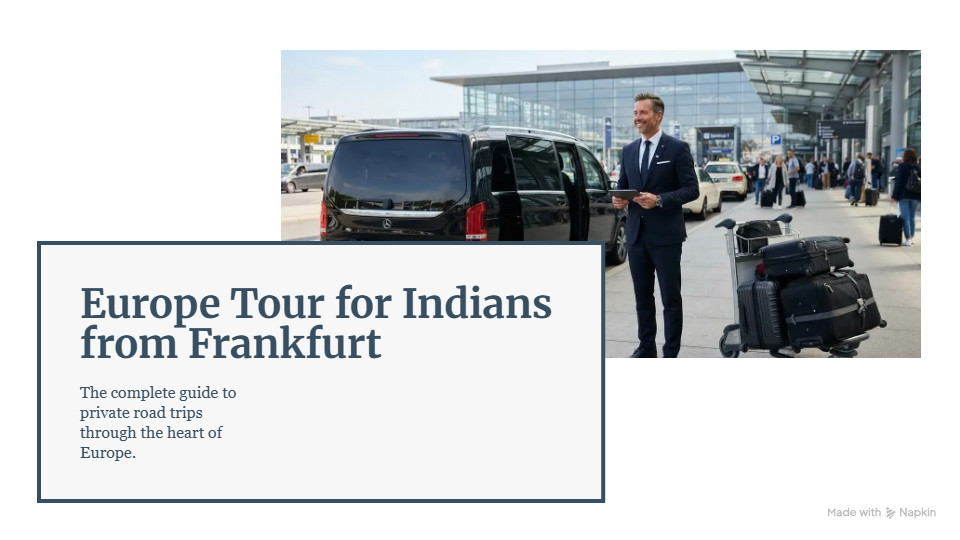
Most Indian travellers land at Frankfurt Airport, and from there Switzerland, Paris, Amsterdam and the Alps all sit within one day’s drive. A private Europe tour for Indians from Frankfurt gives you your own car, a driver who speaks Hindi, Punjabi and Urdu, veg-friendly meal stops, child seats, and one fixed price agreed before you leave.
Alt: Indian family met by their private driver at Frankfurt Airport at the start of a Europe tour
Why start a Europe tour for Indians in Frankfurt?
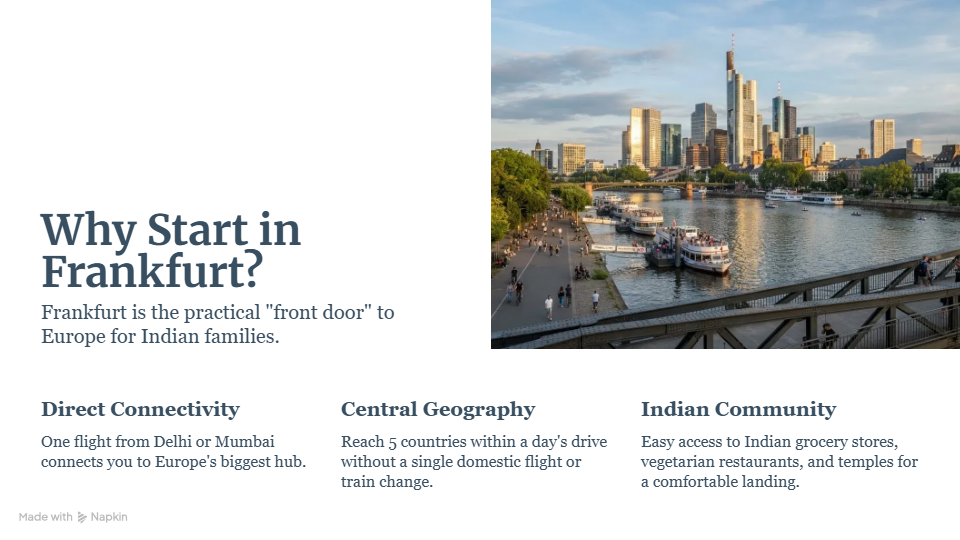
Frankfurt is the practical front door to Europe for Indian families: one flight from India, and five countries within a day’s drive. Direct flights connect Frankfurt with Delhi and Mumbai, the airport is one of Europe’s biggest hubs, and the city sits almost exactly in the middle of Western Europe. From Frankfurt you can reach Switzerland, France, Belgium, the Netherlands, Austria and even northern Italy without a single domestic flight or train change.
That geography matters more than most first-time visitors realise. If you land in Paris or Amsterdam instead, every trip into the Alps or the next country costs you a full day of backtracking. Start in Frankfurt and your route becomes a clean loop: Switzerland in the south, Paris in the west, Amsterdam in the north, the Austrian Alps in the east, and home again. Nothing repeats.
Frankfurt and the wider Rhine-Main area also hold one of the biggest Indian communities in Germany, so the things Indian travellers look for first are easy to find here: Indian grocery stores, vegetarian restaurants, and temples. It is a comfortable city to land in after a long flight, especially with children or elderly parents in the group.
Here is what the distances actually look like by road:
| Destination | Road distance from Frankfurt | Driving time |
|---|---|---|
| Cologne | about 190 km | about 2 hours |
| Brussels | about 400 km | about 4 hours |
| Amsterdam | about 450 km | about 5 hours |
| Zurich | about 400 km | about 4 hours |
| Lucerne | about 430 km | about 4.5 hours |
| Interlaken | about 480 km | about 5 hours |
| Paris | about 570 km | about 6 hours |
| Munich | about 400 km | about 4 hours |
| Prague | about 500 km | about 5 hours |
| Milan | about 640 km | about 7 hours |
Times are motorway times without long stops. Add breaks, holiday traffic and weather, and a six-hour day can become eight relaxed hours with lunch and photos. That is normal, and a good plan expects it.
Two small pieces of arrival advice from experience. Do not plan a long drive on landing day; an overnight flight from India lands with everyone wrecked, and the first day should cost nothing more than a walk and an early dinner. And if your tour starts when you land, share the flight number when booking: we track the flight, so a two-hour delay over the Atlantic changes nothing except the driver’s coffee schedule.
The short version: fly into Frankfurt once, and the whole of Central Europe opens up as one road trip loop.
Which Europe tour routes from Frankfurt suit Indian families best?
The route matters more than the hotel or the car. Pick the right loop and every drive stays under six hours, the scenery keeps changing, and the children do not melt down in the back seat. These are the routes Indian families ask us for most often, and the ones we would recommend first.
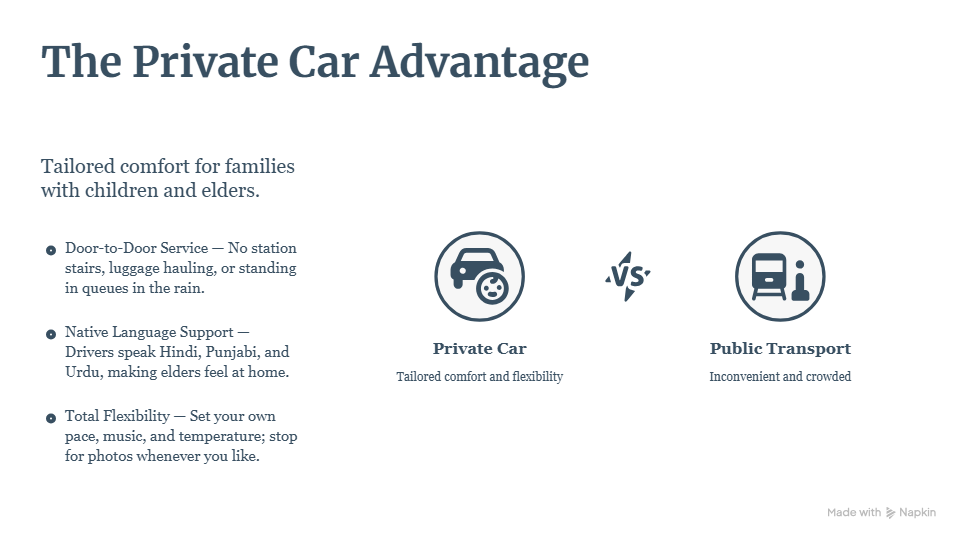
A word on travelling with elders, because Indian group trips usually include them and most travel advice quietly ignores them. A private car removes the three things that wear older parents down fastest: station stairs, standing in queues, and walking from a tram stop to a hotel in the rain. The car stops at the door, the luggage lives in the boot, and the day starts after breakfast instead of before it. Families regularly tell us the elders called this the most comfortable foreign trip of their lives, and the route had less to do with it than the pace.
Frankfurt to Switzerland: the classic first trip
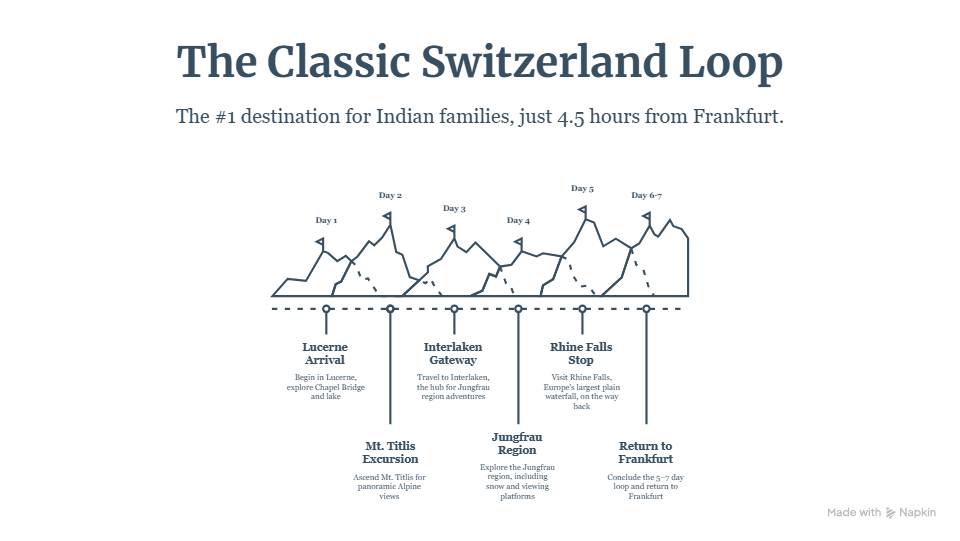
Switzerland is the destination most Indian families put at the top of the list, and it deserves the spot. The mountains are close together, the roads are excellent, and every second day brings a postcard view. From Frankfurt you drive south through the Black Forest, stop at a lake town like Titisee for chai and photos, cross into Switzerland near Basel, and reach Lucerne in about 4.5 hours.
A comfortable first itinerary looks like this: two nights in Lucerne for the Chapel Bridge, the lake, and a mountain excursion, then two or three nights in the Interlaken region for the Jungfrau area. On the way home, stop at the Rhine Falls near Schaffhausen, the largest plain waterfall in Europe, and let the spray cool the kids down. Give this route 5 to 7 days and nobody leaves tired.
What does a mountain day actually look like? You leave after a proper breakfast, because the clouds are usually lowest in the morning and burn off by midday. You ride up by cable car or mountain railway, spend two easy hours at the top with the snow, the viewing platforms and an overpriced hot chocolate, and come down before everyone’s energy and the weather both turn. It is a half-day activity done well, not a full-day marathon, and after it the lake promenade in the evening feels earned.
About Switzerland and money, since someone in the family will raise it: yes, Switzerland is the expensive stretch of any Europe trip. Mountains, meals and mountain town hotels all cost more than their German equivalents. Most families balance it by self-catering breakfasts, buying supermarket supplies for picnic lunches, and putting the budget into one or two great mountain days instead of five average ones. The car itself helps, because you are not paying per-person fares to move between towns.
With your own car you also get something trains cannot offer on this route: weather flexibility. If clouds sit on the Jungfrau on your planned mountain day, you simply swap days, because you are not chained to a rail timetable or a prepaid excursion slot.
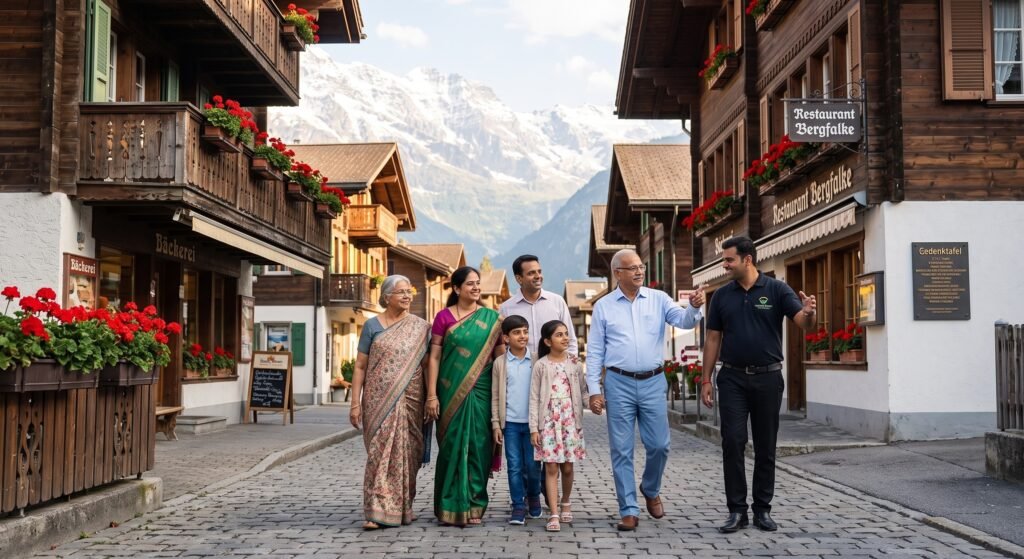
Alt: Family Europe trip viewpoint above Interlaken on a Frankfurt to Switzerland road tour
First trip to Europe with kids or parents? Choose Switzerland. It is compact, safe, and the drives are short.
Frankfurt to Paris: the city every itinerary wants
Paris is about 570 km from Frankfurt, a six-hour run west on fast motorways. Families usually split it: either drive direct with one long lunch stop, or break the journey at Metz or Reims in France and arrive fresh the next morning. Reims, with its giant cathedral and quiet squares, is the nicer overnight if you have the day to spare.
Give Paris three or four full days. The Eiffel Tower, a Seine walk at sunset, the Louvre if the group has the stamina, and a slow evening in a quarter like Montmartre is plenty. Travelling with children? Disneyland Paris sits under an hour from the centre by train and is worth a full day on its own. Paris also has a large choice of Indian restaurants, so dinner is never a problem.
Many families turn Paris into a loop: Frankfurt to Paris, then Paris to Brussels in about 3.5 hours, then Brussels back to Frankfurt. You see three countries in 8 to 10 days without ever packing for a flight.
Frankfurt to Amsterdam: the windmills and canals loop
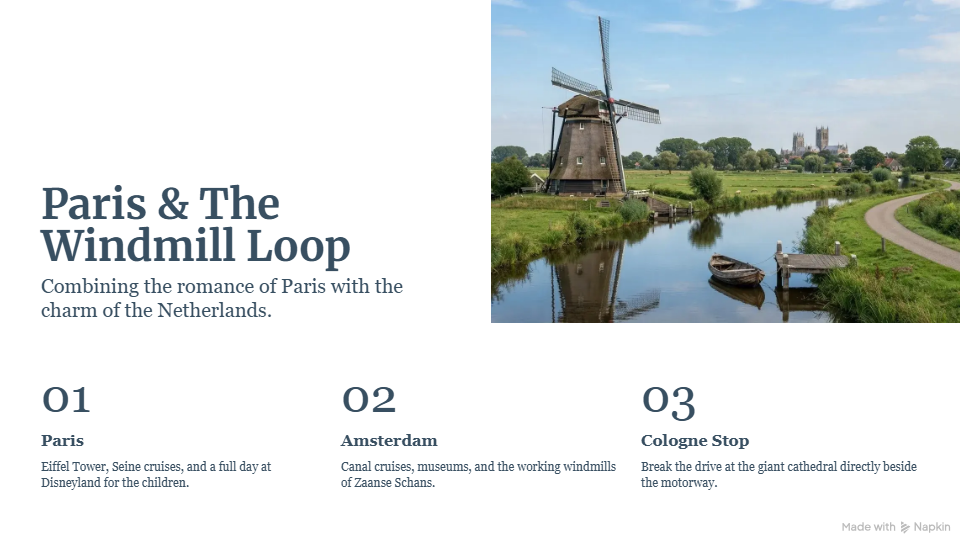
Amsterdam is about 450 km and five hours from Frankfurt, and the drive north is the easiest of the big routes. The natural stop is Cologne, roughly two hours in, where the cathedral stands directly beside the main station. Walk in, look up, and be back on the road within the hour.
The Netherlands rewards slow travel. Zaanse Schans near Amsterdam has working windmills you can walk between; Kinderdijk near Rotterdam has the famous rows of windmills along the water. In spring, roughly late March to mid May, the Keukenhof gardens near Lisse open, and the tulip fields around them turn entire roadsides red and yellow. Amsterdam itself is canals, museums, and narrow streets best explored on foot or by boat.
One honest warning: parking in Amsterdam’s centre is expensive and tight. Most families sleep a little outside the centre or in a neighbouring town, drive in once, and use the tram after that. We plan the day around this so you are not circling blocks with tired children.
A relaxed shape for the Dutch leg: day one for the drive up with the Cologne cathedral stop and an evening walk along a canal; day two for Amsterdam itself, museums in the morning when legs are fresh, a canal cruise after lunch, and the narrow-lane wander in the evening; day three for the windmills and tulip fields on the way out, so the sightseeing happens while the miles roll. Doing it in that order, instead of rushing Amsterdam on arrival day, is the difference between enjoying the city and merely surviving it.
Germany, Austria and Switzerland in one loop
If you have 9 to 11 days, this triangle is the best value trip in Europe, because it stacks three countries and three completely different feels into one drive. Frankfurt to Munich is about four hours. Munich gives you Marienplatz, the English Garden, and beer gardens that are genuinely family friendly, with playgrounds and apple juice for the kids.
From Munich, most groups break south towards the fairy tale castle Neuschwanstein, said to have inspired Disney’s castle, then cross into Austria towards Innsbruck, or make a side trip to Salzburg, Mozart’s city, before swinging west. The Austrian Alps section, Innsbruck to the Arlberg pass, is some of the prettiest driving in Europe. Then you drop into Switzerland at Zurich or Lucerne, roll north past the Rhine Falls, and arrive home in Frankfurt with three stamps’ worth of memories and no internal flight.
Parents visiting from India love this loop because it mixes cities, castles and mountains in gentle doses. Nothing on the route demands hiking boots or long walking days unless you want them.
Frankfurt to Italy: for honeymoons and long holidays
Italy is the far end of the map, and it earns the drive. Milan is about seven hours from Frankfurt [VERIFY: drive time], so this route suits couples and families with 10 days or more. The reward is enormous: Lake Como with mountains rising straight out of the water, Verona of Romeo and Juliet, and Venice, where the road ends and you continue by boat.
Venice deserves a note of its own. Cars stop at the edge of the city, and you walk or take a boat in, which children find magical and parents find surprisingly relaxing once the bags are dropped. Honeymooners usually pair two Swiss nights with three or four Italian nights and fly home from Milan or Venice instead of driving back.
That is the quiet advantage of a private car tour over fixed packages: the route bends around you, not the other way round.
Which route works for a Europe honeymoon tour from Frankfurt?
Couples ask us this more than any other question, and two loops answer it. The first is Paris plus Switzerland: romance in Paris, mountains in Lucerne or Interlaken, home through the Black Forest, done comfortably in 8 days. The second is Switzerland plus the Italian lakes: Alpine mornings, Lake Como evenings, and a slow drive home with stops in the Rhine Valley.
Honeymoons work best with slow mornings and one standout view per day, so we plan them with later starts and fewer hotel changes. A private car also means the two of you set the temperature, the music, and the lunch stop, which no group bus will ever offer.
A quick way to match route to group:
- Family with children under 12: Switzerland, 5 to 7 days, one base per region
- Parents and elders visiting from India: Germany, Austria, Switzerland loop, 9 to 11 days, relaxed pace
- Honeymoon couple: Paris and Switzerland, or Switzerland and the Italian lakes, 8 days
- Group of friends or students: Paris, Brussels, Amsterdam loop, 8 to 10 days
What does a complete family itinerary from Frankfurt look like?
To make all of this concrete, here is a loop we are asked for again and again, written day by day. It mixes Switzerland and Paris in 10 nights, and it works because the geography does the heavy lifting.
- Day 1: Land at Frankfurt Airport, meet the driver, a short hop to the hotel, and sleep off the flight.
- Day 2: Drive south with a Black Forest lunch stop at Titisee, and reach Lucerne by evening, about 4.5 hours in total.
- Day 3: Lucerne: the old town, the Chapel Bridge, a lake cruise, or a mountain excursion if the weather is kind.
- Day 4: A short two-hour drive to Interlaken, with the afternoon free beside Lake Brienz.
- Day 5: Jungfrau region day. Go early, take the mountain railway up, and come down before dinner.
- Day 6: Leave Switzerland with a stop at the Rhine Falls, then drive a few hours north for an overnight in Heidelberg.
- Day 7: Heidelberg castle in the morning, then the longest drive of the trip, about six hours west to Paris.
- Day 8: Paris: the Eiffel Tower, the Seine at sunset, and an early night.
- Day 9: Paris your way: the Louvre, Montmartre, shopping, or a Disneyland day with the children.
- Day 10: Drive back to Frankfurt, about six hours, and spend the evening unwinding near the airport.
- Day 11: Fly home from Frankfurt with three countries behind you.
Families shorten it by dropping Paris and adding Alpine nights, or stretch it by inserting Brussels between Paris and home. The skeleton stays the same: a loop, never a backtrack, with no internal flights anywhere.
How do you plan a multi-country Europe trip from Frankfurt?
Multi-country Europe tour planning sounds complicated until you break it into decisions. Most of the countries on these routes, Switzerland included, sit inside the Schengen area, which in practice means you usually keep driving at borders without a stop. Check that your own visa covers every country on your list before booking, and the rest is just sequencing. Here is the process we use with families:
- Fix your dates and total days first. Count arrival and departure days as half days each. A “10 day trip” is really 8 usable days.
- Choose two or three countries, not five. First-time visitors almost always cram too much. Two countries enjoyed slowly beat five countries seen through a windscreen.
- Order the loop on a map. The route should run in one circle so you never drive the same motorway twice. Clockwise or anticlockwise both work from Frankfurt.
- Send us your traveller list with ages, suitcase count, and food preference. This decides the car, the seating, the child seats, and where we plan proper meal stops.
- Agree the fixed price in writing before the trip. You get one base price covering the agreed plan, with no hidden costs appearing later. Pay by bank transfer, UPI, PayPal or cash, whichever suits you.
- Book hotels with parking, slightly outside city centres. City centre hotels in Paris and Amsterdam charge heavily for parking. A hotel 15 minutes outside, beside a tram or metro stop, usually saves money and stress.
- Keep one flexible day. Weather, a sick child, or a town you fall in love with will claim it. A plan with no slack is a plan that breaks.
On timing: June to August brings long days and full mountain excursions but also crowds, so book the car and hotels early for summer. May, late September and early October are the sweet spots, with good roads and thinner crowds. December has its own magic, with Christmas markets in almost every German town square from late November onwards, though mountain days are shorter then.
How many days should you give each country?
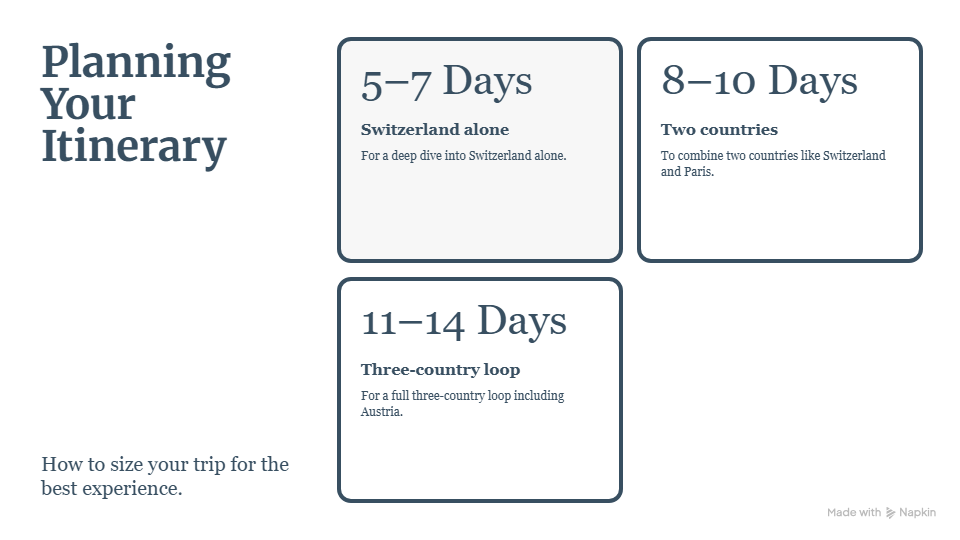
Rough planning numbers, based on the trips we run most: Switzerland alone deserves 5 to 7 days, because the travel days between regions eat time even though distances look small on the map. Paris and France work as a 3 to 4 day block. The Netherlands is comfortable in 3 to 4 days including the drive. Austria earns 2 to 3 days as part of a loop rather than a standalone destination from Frankfurt. Italy is the exception: the drive in alone takes a full day, so give it 4 to 5 nights minimum or pair it with Switzerland on a longer holiday.
The mistake we see most often is not too few days in one country, but too many countries for the days available. A family that tries Switzerland, Paris, Amsterdam and Italy in 10 days spends seven of those days in the car. Cut the list until every stop gets at least two nights, and the trip starts planning itself.
How far ahead should you book? For summer trips, sort the car and the first and last hotels two to three months out, because July and August fill the good family rooms first. For May, September and the Christmas market weeks, four to six weeks is usually enough. Swiss mountain towns are the exception at any time of year: the view rooms in Interlaken and Grindelwald sell out long before the city hotels do, so lock those dates first and let the rest of the route fall in behind them.
On paperwork, keep it dull and simple: passports for everyone, hotel and car confirmations saved offline, prescription medicines in original packaging with a bit of extra supply, and a printed sheet with driver contacts and each night’s hotel address. Dull paperwork is what smooth holidays are made of. Share the same sheet with family back home so nobody in India is refreshing their phone at 2 a.m. wondering where the group has reached.
What does a private Europe tour for Indians cost, and how do you pay?
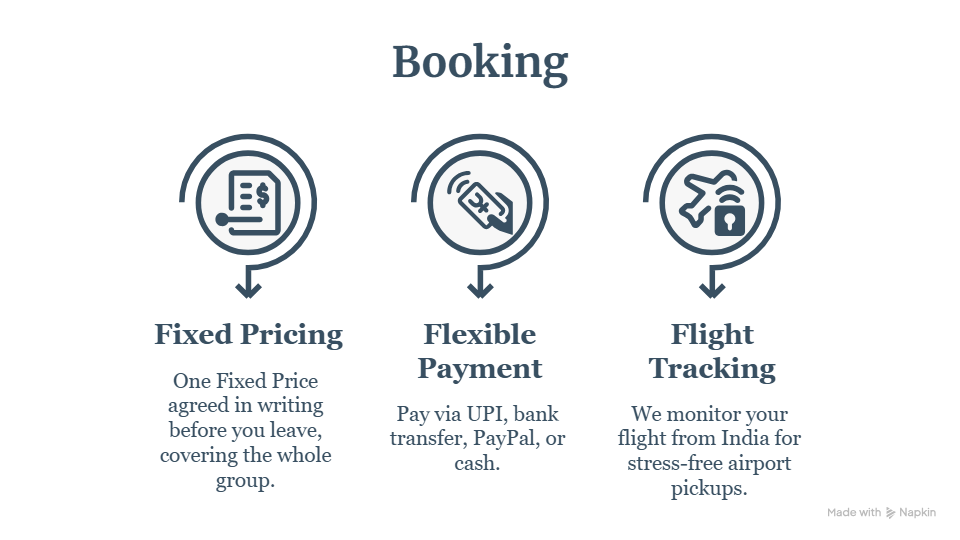
We keep pricing boring on purpose, because surprises on holiday are the wrong kind of memorable. The base price for your trip is fixed before you travel and agreed with you personally, and it does not move once the plan is locked. No hidden costs. What was discussed is what you pay.
The quote depends mainly on four things: the number of travel days, the length of the route, the car you choose, and your group size. A five-day Switzerland loop for a family of four costs less than a twelve-day three-country tour for nine people, naturally. Tell us your plan and you get a clear figure for the whole trip, not a per-kilometre meter that creeps up on you.
Payment is built for Indian customers in Germany and in India alike. You can pay by bank transfer, by UPI, by PayPal, or in cash. If you are booking from India, UPI usually feels the easiest, exactly like paying at home; the details are confirmed with you when the booking is made.
Why does fixed pricing matter so much for Indian families abroad? Because you are budgeting a holiday in a foreign currency, usually against rupees earned or euros saved, and a meter that moves with traffic is a stress nobody needs on holiday. A fixed price means the number you planned the wedding gift, the shopping budget and the tuition fee around is the number you actually pay. Elders in the group relax visibly once they hear the full cost at the start and nothing more at the end.
One habit we recommend to every customer, with any operator: get the full quote and the route in writing on WhatsApp before you pay anything. It protects both sides and makes the trip start calm.
Ask for the final fixed price in writing, pay only through the four official methods, and never accept a “we’ll see” on costs.
Which car will you get, and how much luggage can you bring?
The car is decided by your group, not by what happens to be free that day. When you tell us your traveller count and your suitcase count, we match the vehicle to the trip. Across our vehicles we can carry up to 10 pieces of luggage, and the aim is always simple: every person gets a proper seat, and every suitcase travels out of sight in the boot, not on anyone’s lap.
| Vehicle | Best for | Notes |
|---|---|---|
| Mercedes E-Class | Couples, small families, business travel | A smooth sedan built for long motorway days |
| Mercedes V-Class | Families and larger groups | The most legroom and luggage space in the fleet |
| 5, 7, 8 and 9-seater comfort cars | Joint families and friend groups | Tell us your headcount and suitcase count, we match the right car |
Every car is non-smoking and cleaned between trips. Child seats are fitted on request, so bring nothing from India; just tell us the ages when booking. The service runs 24/7, which matters more than people think: flights from India land at odd hours, and a 6 a.m. pickup should not be a special favour.
If your tour starts the moment you land, we track your flight. A delay out of Delhi or Mumbai is annoying for you, but it is invisible to us: the driver simply adjusts and meets you when you actually arrive, not when the ticket said.
Send your suitcase count, not your hopes. Ten bags means we plan the car around ten bags, and nobody sits with a suitcase between their knees.
Where do Indian families find vegetarian food on a Europe road trip?
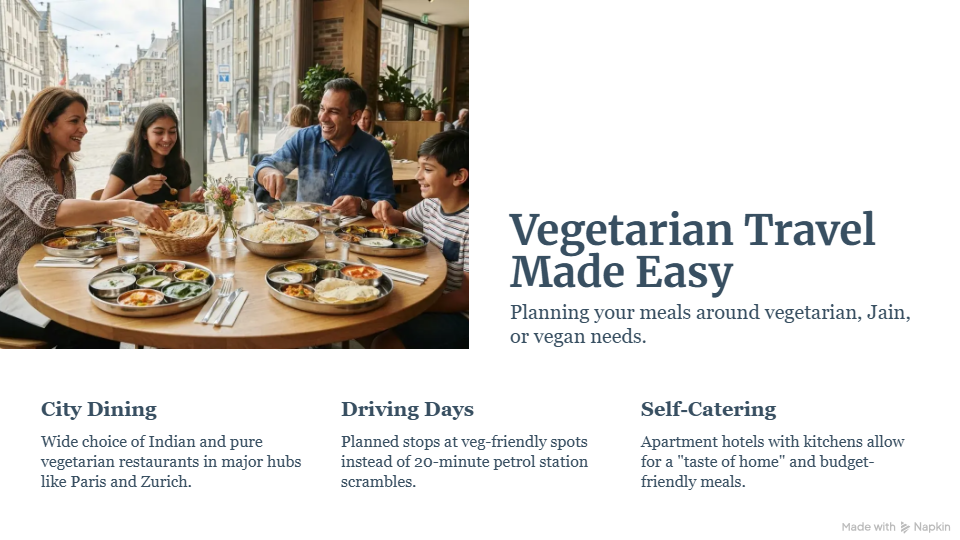
Vegetarian travel in Europe is far easier than it was a decade ago, provided the trip is planned around it a little. Every big city on these routes, Frankfurt, Munich, Zurich, Paris, Amsterdam, Brussels, has a real choice of Indian restaurants, and in most you will find pure vegetarian places without trying hard. The challenge is never the cities. It is the empty stretch of motorway at 1 p.m. on a driving day.
That stretch is solved by planning. Put the words vegetarian, Jain, vegan or no eggs in your first message, and the day plan gets built with a proper lunch stop instead of a 20-minute petrol station scramble. On long driving days many families carry a small bag from breakfast: fruit, bread, cheese or butter, biscuits, and something from home for the children. German supermarkets along the route reliably stock fruits, yoghurt, breads, nuts and ready meals, many clearly marked vegetarian or vegan.
Two habits save most vegetarian travellers in Europe. First, self-cater one meal a day: an apartment hotel with a kitchen turns dinner from a search into a non-event, and plenty of Indian families travel with a small rice cooker or an induction plate. Second, treat restaurant websites or a quick search as your friend in small towns, because the vegetarian option usually exists but hides in the local menu rather than on a signboard.
For Jain and no-onion-no-garlic meals, restaurants become genuinely rare outside the biggest cities, so the plan changes shape: apartment hotels for most nights, groceries from Indian stores in Frankfurt or Munich before the long drives, and restaurant meals treated as an occasional bonus rather than the default. Raise it early, because the route itself can then bend towards towns where your food is actually available.
The rule of thumb we give families: in cities, eat what you like; on driving days, carry backup; in mountain villages, expect cheese, bread, and the view, and plan the real meal before or after.
[[IMAGE: A home cooked vegetarian Indian meal, roti, sabzi, dal and rice, laid out on a table in a bright European holiday apartment]]
Alt: Vegetarian Indian meal prepared in a holiday apartment on a Europe road trip
Can NRIs, students and working professionals in Germany book these tours?
Yes, and they are half our travellers. If you live in Germany, you already know the map: software engineers from Tamil Nadu and Karnataka around Munich and Berlin, healthcare professionals from Kerala in hospitals across the country, automotive and mechanical engineers from Maharashtra around Stuttgart and in Bavaria’s industrial belt, researchers and PhD students in Aachen, Darmstadt, Erlangen and Hannover, and business families from Gujarat and Punjab across the Rhine-Main and Ruhr regions. Weekends are short, parents visit once a year, and the Alps are closer than you think.
The most booked trips from inside Germany are compact ones: a 3 to 4 day Switzerland long weekend from Munich or Frankfurt, a Paris extended weekend, or a Black Forest and Heidelberg Saturday run. Students finish a thesis, group together, and take a 9-seater to Italy or Prague, splitting the fixed price, which works out kindly per person. When parents visit from India, that is the moment for the big Germany, Austria, Switzerland loop, done at their pace, with a driver who can chat with them in Hindi, Punjabi or Urdu the whole way.
Student groups, a word for you specifically. The classic runs are Prague and Budapest when the semester breaks, northern Italy for pizza and Lake Como, or Amsterdam over a long weekend. Nine friends in a 9-seater with luggage for ten between you, one fixed price split nine ways, and a driver who knows where the affordable parking sits outside every old town: it is the closest thing to a self-drive trip without anyone needing a licence or an international permit. Book the car early for semester break weeks, since every university in Germany seems to have the same idea at once.
A note on languages, said plainly: our drivers speak Hindi, Punjabi and Urdu, along with English, German and Italian. We do not claim to speak Tamil, Telugu, Malayalam, Bengali, Marathi, Gujarati or Kannada. In practice, English bridges nearly every conversation, and Hindi works as the common language for most families, but we would rather tell you exactly what you get than promise the map of India.
What does a 3-day Switzerland weekend from Frankfurt look like?
For everyone in Germany with only a long weekend, here is the compressed Swiss plan that works. Day one: leave early, breakfast stop in the Black Forest, and be in Lucerne by early afternoon for the Chapel Bridge and the lake. Day two: the mountain day, Titlis or Pilatus from Lucerne, up after the clouds lift and down by four, then an evening walk through the old town. Day three: the drive home with a stop at the Rhine Falls, and back in Frankfurt by dinner.
Three days, roughly seven hours of driving per day at the edges, one proper mountain, and zero annual-leave days wasted on airports. Couples from Munich or Stuttgart do a version of this by joining the loop from the east through Bregenz. It is the single most repeated request from working professionals in Germany, and it fits almost unchanged into every month of the year.
Tours normally start from Frankfurt. Living in Munich, Cologne, Stuttgart or elsewhere? Fast trains and domestic flights reach Frankfurt quickly, or simply ask us about starting your round trip from your city when you enquire; on longer trips it is often possible, and we will tell you straight either way.
One planning note worth acting on: the year has two rushes. May and June, when Indian school holidays begin, and the Diwali to Christmas window, when parents and working professionals take their big trips. If your dates fall in those weeks, message early, because the larger cars and the best drivers are spoken for first, exactly like flights. The quiet weeks in between are when you get the same roads with more room to breathe, and often the same views with fewer selfie sticks.
Private car, train or group bus tour: what suits an Indian family best?
Trains in Europe are genuinely good, and group bus tours are genuinely cheap, so the honest answer is that it depends on your group. The comparison below is the one we walk every family through, because the wrong choice is expensive in comfort even when it looks cheap on paper.
| What matters | Private car with driver | Trains | Group bus tour |
|---|---|---|---|
| Luggage | Up to 10 pieces in the boot | You carry it on and off | Usually one bag each |
| Pace | You set it, stop when you like | Fixed timetable | Fixed, early starts |
| Food | Meal stops planned around veg needs | Station food | Set group menus |
| Elders and kids | Door to door, no platforms | Steps, changes, stairs | Long sitting days |
| Language | Hindi, Punjabi, Urdu, English | Mostly local signage | Varies by operator |
| Cost shape | One fixed price for the car | Priced per person | Cheap headline, extras add up |
For a family of four or more, with suitcases, children, elders, and vegetarian food on the list, a private car usually wins on every line that matters. The price is one fixed figure for the whole group, the car goes door to door, suitcases vanish into the boot after loading once, and a driver who speaks your language removes the small daily frictions of foreign travel.
For a solo traveller or a couple on a tight budget moving between two big cities, trains can make complete sense, and we will say so. Group bus tours earn their place in one situation: a solo traveller who wants company, or someone taking a first taste of Europe alone before returning for a deeper trip with family. What we would honestly advise against is the 7-country, 8-day group bus sprint with children or elders, where the holiday becomes a blur of 5 a.m. luggage calls and buffet dinners. Europe rewards depth over distance, and the private car exists precisely so you can go deep at your own pace.
There is one more difference that no table captures: travelling with an Indian driver in Europe means the person at the wheel understands the whole trip, and the roads are the smaller half of it. The driver knows why a lunch stop matters at one and not three, why the elders want photos at every bridge, and why the plan can bend without breaking. On a family Europe trip, that familiarity quietly becomes the best part of the journey.
Frequently asked questions about Europe tours for Indians
How many days are enough for a Europe tour from Frankfurt?
Give Switzerland 5 to 7 days on its own. Two countries fit comfortably in 8 to 10 days, and a three-country loop needs 11 to 14. First visits always feel better slow; you can return, but you cannot un-ruin a rushed trip.
Can I book and pay from India before I fly?
Yes. Planning happens on WhatsApp with real people, the fixed price is agreed before you travel, and you can pay by bank transfer, UPI, PayPal or cash. Many customers arrange everything from India and simply land at Frankfurt Airport where the driver waits with the car.
Do your drivers speak Hindi?
Yes. Drivers speak Hindi, Punjabi and Urdu, plus English, German and Italian. Parents and elders who are not comfortable in English usually settle in completely once they realise they can speak freely in the car.
Is a private Europe tour better than Eurail for a family?
For a family of four or more, usually yes: one fixed price for the car, luggage in the boot, door-to-door hotels, and meal stops planned around vegetarian food. For one or two adults moving between two big cities, trains can be cheaper and work well. Tell us your group and we will tell you honestly which side you fall on.
Where will we find vegetarian food on the way?
Every major city on these routes has Indian and pure vegetarian restaurants. The gap is motorway stretches on driving days, so we plan lunch stops around your preference when you book, and most families carry a small snack bag for between meals. Supermarkets across Germany, Switzerland, France and the Netherlands stock vegetarian items daily.
Can the tour start from Munich, Stuttgart or Cologne instead of Frankfurt?
Standard tours start from Frankfurt, and that is where the car and driver are based. On longer round trips a different start city is often workable; ask on WhatsApp with your dates and cities, and you get a straight answer the same day. Otherwise, fast trains bring you to Frankfurt from most German cities in a few hours.
Is the price per person or for the whole trip?
The base price is fixed for the agreed trip, not a per-person fare, and it is settled before you travel with no hidden costs. What changes the figure is the plan itself: days, route length, and car. Change the plan before booking and the quote changes openly with it.
Ready to plan your Europe tour from Frankfurt?
You now have the full picture: why Frankfurt is the best entry point for a Europe tour for Indians, which loops work for families, honeymooners and student groups, how the fixed pricing and UPI-friendly payment work, and how vegetarian food, luggage and child seats get handled before you even land.
If this is your first trip to Europe and the planning feels heavy, remember that every family that messages us starts exactly where you are standing now: a wishlist of countries, a browser full of tabs, and a mild fear of getting it wrong. The fix is a single conversation. Routes get shortened, hotels get moved, and within a day or two the plan stops being a research project and starts being a holiday. That is the whole job.
The next step takes five minutes. Message or WhatsApp us at +49 1521 3625157, or visit namastetrip.de, with these five things:
- Your travel dates and total days
- The countries or cities on your wishlist
- Number of travellers and their ages
- Your suitcase count and food preference
- Child seat needs, if any
You will get a route suggestion, the right car from the Mercedes E-Class, V-Class or the 5, 7, 8 and 9-seater comfort cars, and one fixed price in writing. No hidden costs, no pressure. CAB by Sunny Singh, powered by NamasteTRIP, runs 24/7 from Frankfurt am Main, with drivers who speak Hindi, Punjabi, Urdu, English, German and Italian.
Your side of Europe is four hours down the road. Come see it.